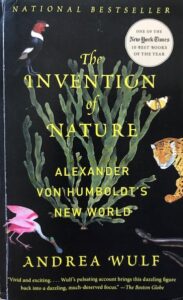
The Invention of Nature: Alexander von Humboldt’s New World. Andrea Wulf. Vintage Books. 2016.
Soft cover. Glued. 552 p. Notes. Notes on Humboldt’s Publications. Index. 1.2 pounds. Discovered at Eureka Springs Carnegie Library; purchased at Alibris.com.
Dear Andrea Wulf,
It’s obvious you respect Alexander von Humboldt and have a great deal of enthusiasm for his accomplishments. I first came across your work through the graphic novel adaptation of it, drawn by Lillian Melcher, at our local library. Once I understood it was based on a text-based book, I sought it out, and to my astonished pleasure, my small library also had that, which I gobbled up as well. Thanks to these two books of yours, I too have become a great enthusiast of Alexander von Humboldt.
I read a lot. I’m an American who’s country has the name Humboldt across the continent in counties, mountains, towns, and more. And yet, I’ve not heard of Humboldt the man. How can this be? I’ve read Thoreau, Muir, Darwin. I read about ecology all the time. My initials spell ‘web,’ and it was Humboldt who helped western science see the ‘web of life.’ And yet I have not heard of this man until reading this book.
How could the most famous scientist of his time be virtually unknown today? On the 100th anniversary of his birth (b. September 14, 1869) he was celebrated with parties in Europe, Africa, Australia, and the Americas. Commemorations were held in his honor across the U.S. including 25,000 people gathered to hear speeches about him in Central Park, NYC. In Berlin 80,000 people gathered to hear speeches in torrential rain. How is it that this celebrated man of science is hardly spoken of at all today?
This is not a mystery book; your intent is not to parse answers to the above questions; I ask them because after reading your book, I’m simply astonished at how much this man influenced so many other scientists, artists, writers, politicians, and more, and is yet so unknown. Thanks to your book, I’ve read Darwin’s The Voyage of the Beagle and I now have a scientific interest in lichen. I also have a new respect for scientific instruments and how they’re used to measure what we know, which I’ll come back to later.
A key aspect of your book that I enjoyed so much was not just Humboldt’s own history, which is fascinating in and of itself; but also how Humboldt influenced so many other pivotally influential people. Your clear writing, obvious respect for the topic of science, and thorough research shine through in every page and help bring Humboldt and the people he influenced into a genealogy of scientific and cultural thought.
Indeed, you contend in the prologue—and give supporting evidence in the book—that Darwin would not have taken The Beagle voyage nor written On The Origin of Species without Humboldt’s influences; that Simon Bolivar was heavily influenced by him while struggling for South American independence from Spain; that Wordsworth and Coleridge incorporated his thinking of nature into their poems; that Thoreau’s Walden would have been far different without Humboldt’s influence; and that Goethe also was heavily influenced and inspired by Humboldt.
You have a chapter on Haeckel, who gave us the word ‘ecology’ based on reading Humboldt and who drew some of the most remarkably detailed renditions of unseen nature, which in turn influenced the Art Nouveau movement. Another chapter on Muir, who helped create Yellowstone Park thanks in part to Humboldt’s’ influence. And another on George Marsh, who in the mid-1800’s was already denouncing humanity’s long-term impacts on the earth’s climate, first inspired by Humboldt’s own observations from decades earlier.
I appreciate that you spend just enough space to talk about his upbringing and the cultural context of the time of his birth and youth. Only 13 pages give us this information, out of 398 pages of the book’s main body; and yet, thanks to your clear and concise writing, I’m given enough detail and context to understand Humboldt the man, the traveler, the scientist, and the reveler searching for new connections.
I particularly enjoy how you connect early influences to later accomplishments. “Comparison became Humboldt’s primary means of understanding nature, not abstract mathematics or numbers.” This sentence comes after describing some of the interactions he had as a 20-something year old with Goethe, Germany’s great poet and scientist, as they discussed some of the latest scientific questions about life and what animates it.
But the sentence also reinforces an overarching theme of yours about Humboldt: that while he was firmly planted in The Enlightenment and the emerging scientific trend to compartmentalize into newly named studies (i.e.: botany, zoology, geology, chemistry), Humboldt was also continually seeking how to re-connect those disparate studies back into the bigger picture.
Which brings me to your title: The Invention of Nature. You repeatedly remark on how Humboldt took the specific lessons he learned from his relentless measurements and broadened them into understanding the complex web of life. As you mention, like his predecessors and contemporaries, Humboldt could dissect nature into its many parts, but unlike his colleagues, he reassembled those parts to create a fuller understanding of nature itself. He broadened the concept of nature from one of mechanistic parts into a being in and of itself.
This climax of his thinking actually comes relatively early in his life. In his late 20’s/early 30’s, Humboldt had taken a five-year trip through South America. Halfway through that trip, on his climb up Chimborazo, then-believed to be the highest mountain in the world (in what is now Bolivia), Humboldt sees and understands global connections in nature.
Out of this climb up this mountain, he understands the connections between different plant species that grow at certain altitudes and/or latitudes. If that were all he had done, that would be remarkable enough. But he is able to convey this complex thought about the interrelatedness of plants to climatic conditions in a picture he drew! As a fan of non-fiction graphic novels, I find it compelling that he could present such detail not in charts and tables but in a drawing.
And he goes on, eventually writing a whole book just to explicate this one picture into a broad view of nature itself. He noted and understood that the air was full of pollen, seeds, and insects and their eggs; he noted the temperatures, atmospheric pressures, and humidity at different altitudes; and he compared these notes from this one mountain to similar notes of other mountains across the globe.
Out of this work he invents the concept of isotherms and isobars, the wavy lines we almost take for granted on world maps showing where there are similar temperatures and air pressures. I’m amazed at how you gracefully trace these insights of his from those who influenced his own thinking to how he then in turn influences others. Sir Charles Lyell takes the concepts of isotherms and applies them to his own work on global Principles of Geology that in turn heavily influences Darwin in his work on evolution!
Speaking of influences…your book is not an exhaustive biography of the man. It is instead a broad-stroke picture of Humboldt the scientist, how he was influenced by his culture, his time period, and the people around him; and in turn how he influenced the science, people, and culture during and after his time. This makes the book a fascinating account of how one person can be such an influential nexus of thought, activity, and creativity.
Despite not being an exhaustive account, there is simply too much in your book for me to discuss in this review. For those reading this review letter, just go get this book from your library, or buy it, and read it!
For you, Ms. Wulf, I have one final thought I wish to explore and ask you about: I’m curious about the instruments Humboldt used on his travels in South America, throughout Europe, and in Russia.
Being skilled at measuring things is so pervasive in modern society, it’s almost easy to forget how important and instrumental it is. Cooking comes to mind: tablespoons, teaspoons, cups, and pints; oven temperatures; time durations. All of which I take for granted; most of the time I give no thought at all to just how scientific my cooking is compared to how cooking was done just 150 years ago. I’ve read M.F.K. Fisher’s works, where she relays old-time recipes that don’t come close to anything measurable. How anyone managed to cook from those recipes is a mystery to me.
When I worked in construction I had so many different ways to measure I can hardly count them all: tape measures from 10’ to 100’ long; yard sticks; framing squares; speed squares; laser measures; measure wheels; rulers as fine as 1/64th an inch; levels and plumb bobs; combination squares; straight edges; and too many more to list.
At my current work in grocery, I’m measuring square footage and linear footage; sales; sales per labor hour; case sizes; pallet sizes; shelving sizes; and so on.
We Americans are dragging ourselves, kicking and screaming, into the world of metric measurements through our automobile repairs. I have two sets of wrenches, one standard, the other metric. I have almost developed an intuitive sense of just how long 10 millimeters is.
You mention that on Humboldt’s trip to South America, he had a sextant, herbarium, telescopes, microscopes, pendulum clock, compasses, barometers, and more. In fact, he had forty-two instruments in total! He used them to measure electricity in the air, preserve plant specimens, read air pressure and temperature, and so much more.
I’ve searched your notes, and the best I can see is that these references to the instruments he used come from his personal diaries, letters, and other books my small library will never have.
In this time period when so many people are questioning science, the scientific method, and the conclusions from science experiments, I would love to see further availability of information about the actual act of measuring. How do we know what we know? How confident are we in these measurements? How are those instruments actually made, how do they function, and how can they be appropriately used?
I would find it fascinating to learn more about scientific instruments. I am woefully ignorant of how a barometer works. I have a rudimentary idea of how microscopes and telescopes work. I have no idea how one measures electricity in the air nor what a sextant even does.
Do you have recommendations on how I could learn more about the actual scientific instruments scientists used during The Enlightenment? It seems like a good way to introduce myself further to the methods of science if I began with science’s first rudimentary steps into measuring things.
In fact, what I would find really incredible is a whole video series on the instruments Humboldt carried on his trip to South America. Each segment covering one of the instruments he used; how it was made; how it was used; how the data was collected; and how the data was interpreted and applied to the greater scientific knowledge.
What leads can you offer to help one understand the scientific measuring instruments of Humboldt’s time period?
Thank you for writing this book and the graphic adaptation; thank you for your enthusiasm for Alexander von Humboldt and the Web of Nature; and thank you for your time in reading and replying to this Review Letter.
Other reviews that mention this post: Entangled Life, Gastrophysics, Essay based on The Science of Storytelling, Essay on Perception,
You know who else should be better known: Alexander’s brother Wilhelm, a linguist. He was a polyglot, and analyzed linguistic structures for their relationship to thought. He believed some languages were better than others (Sanskrit, Latin), which doesn’t go down well these days. But the suggestion that variations in grammatical relations from one language to the next will make for different mental habits is plausible and, in Humboldt’s hands, fertile.
Thanks for your review. It reminds me that I want to read this book.
In Andrea Wulf’s telling of Alexander’s story, Wilhelm plays a large role. Apparently the two brothers were in equal parts rivals with, goads towards, and supporters of each other. She mentions their correspondences between each other, and how they often visited with each other no matter where they each lived in Europe. Wilhelm was stationed throughout Europe as a representative of the Prussian country, and so put his linguistic skills to much use. Wilhelm introduced Alexander to Goethe, who was highly influenced by Alexander and who in turn highly influenced Alexander. You will see much appreciation for Wilhelm when you read Wulf’s book.