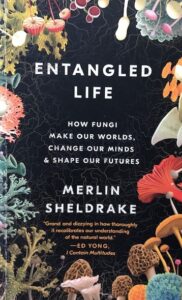
Entangled Life: How Fungi Make Our Worlds, Change Our Minds & Shape Our Futures. Merlin Sheldrake. Random House. NY. 2020.
Soft cover. Glued. 352 p. Notes. Bibliography. Index. Illustrations by Collin Elder using ink from Shaggy Ink Cap Mushrooms. 0.6 pounds. First heard about in The Sun, purchased at Literati Bookstore.
Dear Merlin Sheldrake,
While on a trip to visit a friend I came across your book in a delightful independent bookstore, Literati, in Ann Arbor, Michigan. Instead of waiting for the book to arrive in my local library, I splurged on buying it. I’m glad I did.
I first heard about this book from an interview you did for The Sun, with Mark Leviton interviewing you. The article includes a photo of you holding your book with a mushroom sprouting out of it; I found that quite hilarious. I reconnected back to that amusement when I read the spore of the idea for that photo at the end of your book.
Here is a specific topic—fungi—that exhibits many of the ideas Alexander von Humboldt proposed two centuries ago (The Invention of Nature, a previous book review). I am, in fact, enthused to see you mention Humboldt several times in your book. His ideas influenced Ernst von Heckel to coin the term ecology, who was trying to capture Humboldt’s views that all of life formed a web of interactions. And like Humboldt, you too seem to remain vigorously scientific while also waxing poetic on the wonders of science.
Your Introduction, What Is It Like To Be A Fungus, is emblematic of your whole book and of why I at first thought I could not write a review. In this intro, you disperse a whole bunch of ideas about fungi and their amazing qualities, abilities, and applications. You also write about your personal explorations, experiences, and ruminations. Finally, you write about the science behind fungal studies and the interconnectedness of different science departments required to understand fungi better. In short, the book doesn’t fit into a neat category; the book is a meshy web like the topic you’re writing about, making it all that much harder for me to review as well.
But this is also what makes your book so fascinating to me, and how it is helping to bear fruit in my own thinking. Fungi, it seems, lie at the borderlands, where definitions are harder to pin down, neat clear lines become blurred, traffic flows between the two entities far more than first realized. I like borderlands; lichen are one such example.
I have a pickup truck that, alas, I don’t always care for very well. I didn’t wash it for awhile, and here in the Ozarks with the high humidity, high pollen count, and a diverse woodland ecology, my white-painted truck began to grow lichen on its surface in less than a year.
I’ve hiked out west quite a bit, in the Sierra Nevadas, the Sangre de Christos, the Olympics, and the Rockies. Lichen seemed to be everywhere I looked, clinging to rocks, flaking off, flowering; just simply pioneering life where there was none before. Here in the Ozarks, one can tell if a rock has been disturbed recently by whether or not it has lichen on it.
In short, for this amateur naturalist who simply observes and nothing more, lichen is everywhere. Your discussion of it is so informative, fact-based, humbling for the ignorance we still have about it, and inspiring, that it makes me want to get a microscope so I can examine it more on my own. I mean, using queer theory to assist in studying and understanding lichens?! I love it. (As Sheldrake quotes a lichen scientist, just search ‘queer lichen’ and the paper will come up.)
You disperse these ideas—about lichen and symbiosis, hyphae and decision-making, mycorrhizae and identity—but you then explore them and find ways to bring these ideas back together into webs of interconnections.
I wish the book had a glossary. It took me awhile to understand how each chapter explores the various marvelous parts of fungi: hyphae, mycelia, mycorrhizae, fruiting bodies, and how they all communicate. Hyphae are the tips growing and exploring the soil; mycelia are the web-like strands that the hyphae are the tips of; and mycorrhizae are the mycelia that infiltrate or interconnect with plant roots. Fruiting bodies are the mycelium bundled together and are usually the most conspicuous part of the fungal body; they are the mushrooms we humans eat. Fruiting bodies can also be the yeasts we use to bake bread or produce alcohol.
With each part of the fungi, you explore the difficulty our human brains have in understanding a living entity that is so different from us. Hyphae grow and explore, seemingly making decisions on where to explore, where to grow, and where to avoid, but with no nervous system. Mycelia develop into complex web-like structures that can have, literally, miles of strands in just a few cubic inches of soil, making them potentially some of the most-abundant lifeforms on earth; lifeforms we walk upon everyday without ever noticing just how prolific they are. And mycorrhizae defy our human needs for simple categories by breaking down our concept of where the plant begins and the fungus ends. In fact, mycorrhizae’s hyphae infiltrate plant root cells, creating symbiotic relationships in which neither could thrive, or sometimes even survive, without the other.
You talk about how the study of fungi pushes the boundaries of scientific thinking; we know so little about fungi that the field is still ripe for speculation. Lay scientists can and do still impact the science, much as they had in the past with other fields of science.
Lichen became and is still a keystone example of symbiosis, that two organisms from different kingdoms of nature could hook up for mutually beneficial purposes, where neither is the parasite and neither the victim, but both survive where they could not alone. It’s not just lichen, but also plants: at a microscopic view, there is no separation between plant roots and fungal mycorrhizae. We have to zoom out our view before we can see a border between the two; zoom in and there is no border. How do we classify the plant’s or fungus’ phenotype and how far that phenotype extends beyond the physical body when they are so intertwined?
And how do we classify a book that chooses to honor science and scientific thinking while also exploring the limits of that thinking? How do we approach a book in which a scientist is willing to be the subject of study as much as being the investigator? How do we read a book that meanders from a scientific fact to a musing on that fact to a reach for speculation before hooking back into the science?
I read this book with the same enjoyment I have when following a narrow deer trail in the forest of a watershed. There’s little likelihood of getting really lost, but there’s always a pleasant surprise around every corner.
This book may be a little off-putting for those who want just straight science, whatever that might be. But when they read the 50 pages of Notes and the 40 pages of Bibliography, they will see that this book a firmly rooted in scientific research.
The structure of your book’s main body, the intertwining of science with the personal, stymied me so much that I almost did not want to write a review of this book. How do I comment on, or include, these more personal interconnections? I can’t really, so I just simply encourage readers of this Review Letter to go get a copy from their library to read it for themselves to see how your very writing style mimics the hyphae and mycelium you write about. Readers will understand how those experiences disperse their own spores into better scientific understanding of this remarkable lifeform called fungi.
After reading your book, I jotted down in my journal several ‘curiosity questions’: Could fungi help convert drawn-down carbon into usable or storable products, like building bricks? Why hasn’t wood-digesting fungi—which evolved after coal first formed from un-rotted wood—digested all the coal since evolving? And could it be that fungi and humans developed a certain symbiosis around the yeast that makes alcohol, like a certain fungus has a symbiotic relationship with Leaf-Cutter Ants?
But I think my most pressing question regards lichen. How can I, as a lay person, learn more about lichen? What books would be good for the average person to start to learn more? And as a citizen scientist, what resources are available to help me to contribute to the study of lichen?
These same questions can be asked for each fungal form: forest-based mycelium; other fungal interactions with plant stems, leaves, and flowers; fungus growing among us inside our books, roads, and buildings; mushrooms and their physical mechanics; and spores and other dispersal methods? In other words, I’m looking for a short list of Further Reading for the Lay Person and a short list of Resources for the Lay Scientist to learn and to contribute. Can you help?
Thank you for writing this book.
Other posts that mention this review: Essay based on The Science of Storytelling